

MyHealth@EU Laboratory Report
9.2.0 - trial-use
150
MyHealth@EU Laboratory Report
9.2.0 - trial-use
150
MyHealth@EU Laboratory Report - Local Development build (v9.2.0) built by the FHIR (HL7® FHIR® Standard) Build Tools. See the Directory of published versions
| Official URL: http://fhir.ehdsi.eu/laboratory/ImplementationGuide/myhealth.eu.fhir.laboratory | Version: 9.2.0 | |||
| Active as of 2026-11-21 | Computable Name: MyHealthEuLaboratoryIg | |||
Specify a set of rules to be applied to HL7 FHIR to define how to represent a Laboratory Report for the European cross-border exchange, coherently with the European eHN Guidelines (see the European eHealth - Key documents).
This Implementation Guide applies to laboratory reports within the core fields of in-vitro diagnostics (e.g. clinical biochemistry, haematology, microbiology, …), while leaving out some specialised laboratory domains like histopathology or medical genetics.
This guide is based on MyHealth@EU Core and the HL7 Europe Laboratory Report HL7 FHIR IGs, fulfilling the MyHealth@EU Functional Requirements: profiles derive from one of them and, where they derive from MyHealth@EU Core, also impose the corresponding HL7 Europe Laboratory Report profile (see the MyHealth@EU Laboratory Models Overview page).
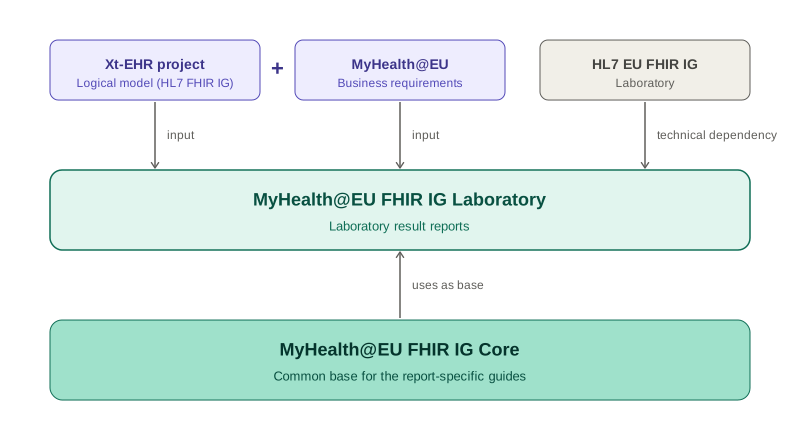
The Use Case originates from the Change Proposal produced by the X-eHealth project/MyHealth@EU New Use Case Workgroup, and the details are available in the corresponding Change Proposal: CP-eHealthDSI-073: Implement the new service Laboratory Result Report (the service was introduced with Wave 8 of MyHealth@EU). This version of the guide is the release for Wave 9.
The corresponding eHN Guidelines: eHN Laboratory Result Guidelines (release 1) are available here.
The solution adopted by this guide - and detailed in the HL7 EU Laboratory Report Design choices page - balances the business requirement of Laboratory Report as legally signable document (i.e. as a HL7 FHIR document), with the expectation to get Lab Report by searching per DiagnosticReport. All this, taking into account the R5 DiagnosticReport design pattern where the DiagnosticReport - Composition relationship is directed from the DiagnosticReport to the Composition resource.
This is done by supporting both perspectives (see figure below) requiring the document bundle ( BundleLabReportMyHealthEu ) to always include a DiagnosticReport ( DiagnosticReportLabMyHealthEu ) and enabling the pre-adoption of the R5 rules for the inclusion of entries in the Document Bundle.

Figure 2 - Overview of the report design approach
The following diagrams provide a browseable overview of the profiles specified by this guide (not all the relationships have been reported).
The first highlights the most relevant relationships starting from the DiagnosticReport ( DiagnosticReportLabMyHealthEu ) resource (REST Perspective).
Figure 3 - Overview of the profiles relationships
The second the profiles included in the document bundle ( BundleLabReportMyHealthEu ) (Document Perspective).
Figure 4 - Overview of the document structure
IG © 2023+ MyHealth@EU. Package myhealth.eu.fhir.laboratory#9.2.0 based on FHIR 4.0.1. Generated 2026-11-21
